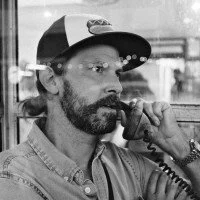
Ryan Steven Green’s latest documentary will screen at Difficult to Name Friday night.
You've made amazing documentaries about everything from mustaches to ephemeral art. The one thing that unites all of your films is your incredible curiosity and generosity toward the people and ideas at the center of your work. How did you first get involved in documentary filmmaking?
It’s a question I have considered myself! There was no single moment, but a long process of little and bigger moments that kept me walking down this path. Even as a teenager I was working both in narrative as well as documentary. In film school (USC, class of ’03) and early in my filmmaking career I thought I was working towards narrative feature films in the vein of Michelangelo Antonioni. Zabriskie Point remains one of my all-time favorite films. As I continued to hone my practice, what started happening was when I’d watch my narratives—usually comedy shorts—I was never fully satisfied with the result, they felt dull. But when I’d watch my documentaries the opposite would happen—my docs simply crackled with life and freshness; somehow the non-fiction format just made sense to me both from a production but also an aesthetic viewpoint. I began wanting to see the documentary films that only I could bring into existence, if that makes sense.
Your latest documentary, Nest: 36 Years at Sinaloa, is your most personal film to date and a beautiful one at that. What was the process for approaching the filming and editing of the piece, given the subject?
For reasons you just stated, I knew this was going to be the most difficult film I've made to date. More than 40 documentaries I’ve made at this point and this is the first film in which I am the main character, my first film written from a first-person point of view. Lots of discomfort there. I gave myself a lot of grace during, especially editorial where lots of time was spent poring over what's left of the family archive of photos, listening to loads of sad music connected to my youth growing up in Altadena. Some days I could manage just an hour of work before having to step away. The worst part was watching news footage of the Eaton Fire event, and in particular the live broadcast of the Green family home fully engulfed in flame. I actually delegated the initial round of seeking broadcast footage to my best friend so I could delay facing that for as long as possible. With just a 13-minute runtime, this film packed more pain into production than either of my feature-length docs.
I'm gonna steal something from Nate Silver's podcast and ask if there are three books you'd recommend.
I love this question! I'm an incessant reader and have curated these recommends to those texts that have a fighting chance of somebody actually picking them up to read! I highly recommend California: A History by the late USC Professor of History and former California State Librarian, Kevin Starr. Thrilling! Choice Cuts, edited by Mark Kurlansky, includes the scrumptious subtitle: “A savory selection of food writing from around the world and throughout history." It is a book that you can pick up and put down for bitesize morsels of food writing. There are many books that I’ve read multiple times. Chief among these are the works of J.R.R. Tolkien. Love me some Hobbit—highly recommended. I’m currently reading Lord of the Rings for probably the fifth time—this time aloud to my six-year-old son (we're about halfway through The Two Towers currently).